The End of MAGA
The war in Iran, an administration that could not separate American interests from Israel's, and a ballroom that came to symbolize Washington's money culture have ended the movement Donald Trump built. Its principles will outlast it.
Donald Trump enters the last two years of his presidency with 32 percent of Americans approving of his performance, according to a Reuters/Ipsos poll taken Nov. 10, near the lowest point of his political career. Democrats will take control of both chambers of Congress on Jan. 3, with subpoena power and a list of investigations already drafted. His chief of staff, Susie Wiles, left the post on Nov. 6 and was replaced by Stephen Miller. A presidency that began in January 2025 with control of both chambers and a clear mandate is now a lame duck with more than two years to run.
The movement that elected him has also reached its end in the form he gave it. MAGA was a coalition of nationalists, populists, opponents of foreign wars and party loyalists, held together by one man's promise to end those wars, clean up a corrupt capital and put American workers first. Over the past nine months the president broke the first promise and deepened the problem behind the second. The coalition has split along those lines, and many of the voters who joined it in 2016 and 2024 left it this month.
The war that broke the coalition
The United States and Israel attacked Iran on Feb. 28. According to Axios and Reuters, citing officials familiar with the planning, Prime Minister Benjamin Netanyahu urged the president in a Feb. 23 call to strike before the late March or April date American planners had set; both leaders deny that Mr. Trump was pushed. Two days into the war, Secretary of State Marco Rubio said the administration “knew that there was going to be an Israeli action” and struck first to protect American forces. The president answered that he “might have forced Israel's hand.” Either account ties the timing of an American war to another government's decisions.
The war has since followed the course its critics predicted. A ceasefire in April and a memorandum of understanding in June each collapsed, the second in July after Iranian attacks on shipping and the deaths of two American soldiers in Jordan. The Pentagon's count stood at 21 American service members killed and 865 wounded in October, and officials told The Washington Post and the Associated Press that the public figure understated the dead. The White House has asked Congress for $87.6 billion in emergency spending, most of it for the war. The national average price of gasoline, $2.98 the week before the strikes, set a September record and fell back below $4 only this week, according to AAA.
Voters noticed. Sixty-three percent told the NBC News exit poll that military action against Iran was the wrong decision, and 74 percent called the war a crucial or major factor in their vote.
An administration that could not separate the two
The war exposed a division inside the administration over Israel. Vice President JD Vance said in June that the two countries have different priorities on Iran, and he warned Israeli officials who criticized the June agreement against “attacking the only powerful ally” they have. He was the exception. Secretary of War Pete Hegseth, Mr. Rubio, Ambassador Mike Huckabee and the president's lead negotiators, Jared Kushner and Steve Witkoff, kept American policy closely aligned with the Israeli government's aims, and Israel's Channel 12 has reported that Mr. Netanyahu is pressing the president to resume full-scale war now that the midterms are over.
Israel's government pursues its own interests, as every government does. The failure lies with American officials who treated those interests as their own country's, and the cost fell on the America First movement. Tucker Carlson called the conflict “Israel's war,” and the president replied that Mr. Carlson was “not MAGA.” By June Mr. Carlson said he would no longer support the Republican Party, which he accused of deciding policy on “what's best for Israel.” Representative Thomas Massie, who opposed the war from the start, lost his primary in May after AIPAC's super PAC, the Republican Jewish Coalition and a pro-Trump group spent heavily against him. Marjorie Taylor Greene had already left Congress after breaking with the president.
The ballroom
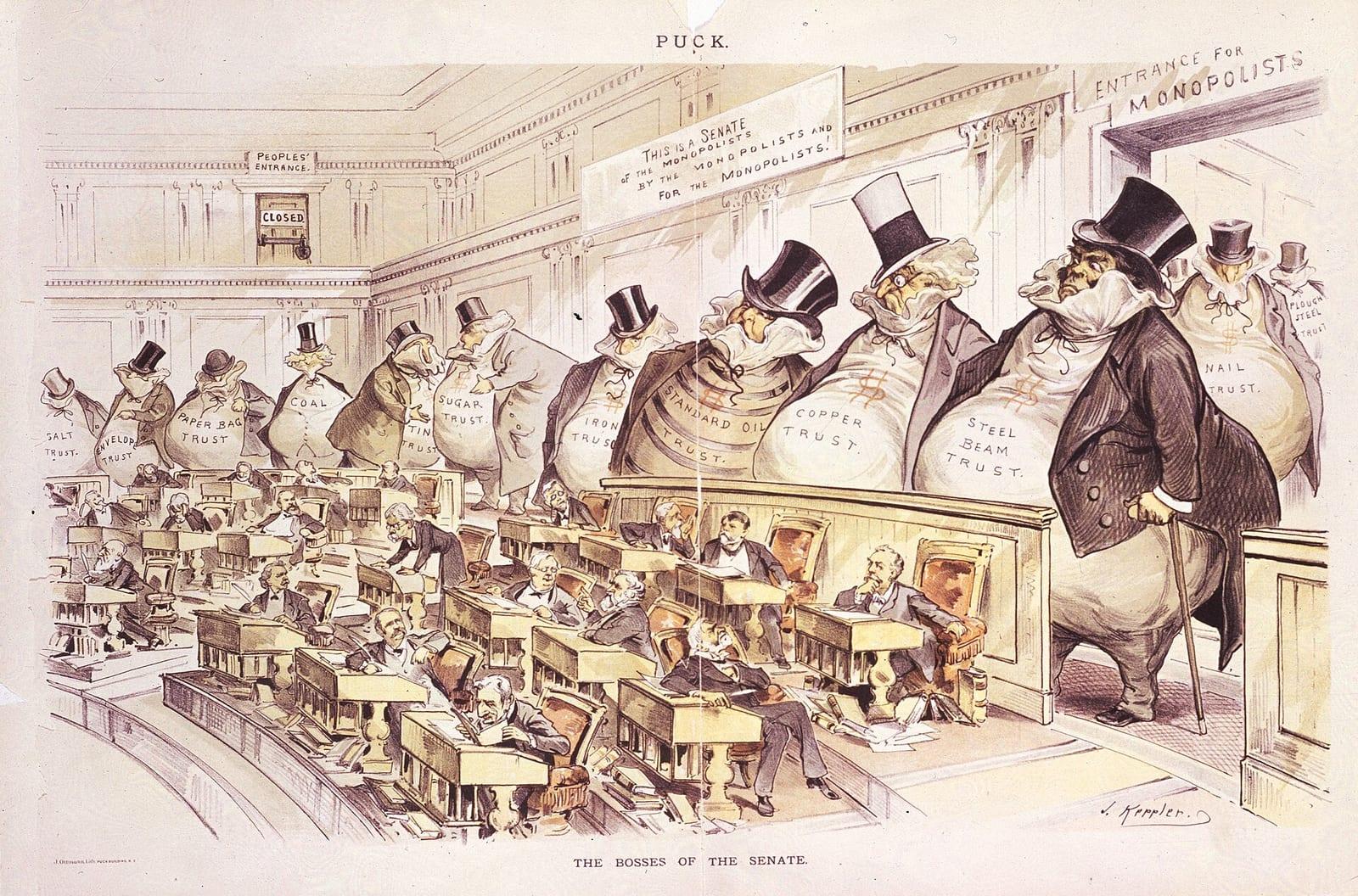
If the war broke the coalition, the White House ballroom came to stand for what became of its promise to clean up Washington. In July 2025 the president described a privately funded $200 million ballroom that would sit near the White House “but not touching it.” In October crews demolished the East Wing. The donors included Lockheed Martin, Amazon, Palantir, Booz Allen Hamilton, Google, Microsoft, Coinbase and Tether, companies with contracts, regulatory matters or policy interests before the federal government. Google's $22 million share came from settling a lawsuit the president had filed against YouTube. Internal construction documents obtained by The Washington Post put the total cost near $600 million, with about $307 million of it paid by taxpayers through the Secret Service and the White House Military Office.
A federal judge halted above-ground construction in March, ruling that the president is the White House's “steward” but “not the owner,” and an appeals court agreed in August that the decision belonged to Congress. The Supreme Court stayed those rulings on the question of standing without deciding the merits, and Congress declined a request for $1 billion toward the project. The president has said the ballroom will open around September 2028, in the final months of his term.
The ballroom is the most visible part of a larger pattern. The president's own financial disclosure reported about $1.4 billion in cryptocurrency income in 2025, much of it from his family's World Liberty Financial venture and from his memecoin. The Wall Street Journal reported that a company tied to the United Arab Emirates' national security adviser bought 49 percent of World Liberty for $500 million days before the inauguration, while the Emirates sought access to advanced American chips; the White House says the deal bought no influence. The president accepted a jet from Qatar for use as Air Force One and pardoned Changpeng Zhao, the founder of Binance, whose company had used the family's stablecoin in a $2 billion deal with an Abu Dhabi investment fund. None of this has been charged as a crime. Ninety percent of voters told NBC News that corruption was a crucial or major factor in their vote.
The case for the president
The president's defenders make a serious case. Mr. Trump removed Nicolás Maduro without the loss of an American life, brought illegal border crossings down sharply, made trade a central question of national policy and killed Iran's supreme leader in the first days of the war. They note that his movement lost the House in 2018 and returned to win everything in 2024, and that most Republican voters remain loyal to him. On that view the coalition is bruised and will recover.
Those achievements are real, and the Society has credited them. The comparison with 2018 does not hold. Those losses followed a first term without a major war, and this year's followed a war most voters consider a mistake. Voters under 30 backed Democratic House candidates by about 3 to 1 in the network exit poll, after splitting almost evenly in 2024. The figures who carried the movement's message on war and corruption, from Mr. Carlson to Mr. Massie, are now outside the party or outside Congress. In a single year the coalition lost its young voters, its most popular commentator and its most consistent opponent of the war in Congress.
What comes next
The president will spend his last two years facing Democratic committee chairmen with subpoena power. According to Bloomberg Government, Armed Services Democrats plan to examine the decision to go to war, Representative Jared Huffman has demanded a full accounting of who paid for the ballroom and what they were promised, and the Judiciary and Oversight committees are preparing inquiries into the family's cryptocurrency ventures and the pardons. Mr. Rubio has denied reports that he will leave before the term ends, and the contest between him and Mr. Vance to inherit what remains of the coalition has begun.
The America First cause will outlast the movement that carried its name. Its principles, a foreign policy judged by American interest, protection for American industry and a government free of capture by donors and foreign governments, never depended on one man, and they command majorities that neither party now represents. The Society will judge the 2028 candidates on whether they hold to those principles in office, including when a foreign government and its lobby press them to do otherwise.
More from the Dispatch
All entries
Where the Young Right Is Going
Young men swung sharply against Republicans this month, campus conservatives are breaking openly with the White House, and a nationalist faction long kept outside the party is gaining ground inside it. The national verdict was a repudiation of the war, prices and corruption. The shift beneath it, toward American nationalism, will shape the party's future.
The 2028 Test
No major candidate has formally entered the 2028 race. The Society sets out the questions it will put to every candidate and its early grades for 34 prospects in both parties and outside them.
What the Voters Rejected
Exit polls show that midterm voters turned against an unpopular war, rising prices and corruption, and gave no sign of rejecting the idea of putting America first.